D/s 24/7: 4 Common Myths to Deconstruct


The D/s 24/7 is intriguing. For some, it is a deep, structured, and highly committed form of relationship. For others, it is a vague concept — sometimes fantasized, sometimes unsettling — often due to oversimplified images conveyed by popular culture, or a lack of understanding of how to live a D/s relationship in a concrete and balanced way.
And that is understandable: “24/7” can sound like permanent control, constant sexuality, or automatic obedience. In reality, most misunderstandings stem from a confusion between fantasy and relational framework — between what one imagines a D/s dynamic to be and what it actually involves on a day-to-day basis.
In this article, we will deconstruct 4 very common myths about D/s 24/7, with an educational, nuanced, and responsible approach: without demonizing, without idealizing, and always reaffirming the essential pillars of BDSM — consent, communication, and safety.
Whether you are curious, a beginner, already in a D/s dynamic, or simply looking for reliable guidance: the goal is simple. To help you distinguish what belongs to cliché… from what can genuinely work, in a healthy way, for certain people.
What is D/s 24/7, concretely?
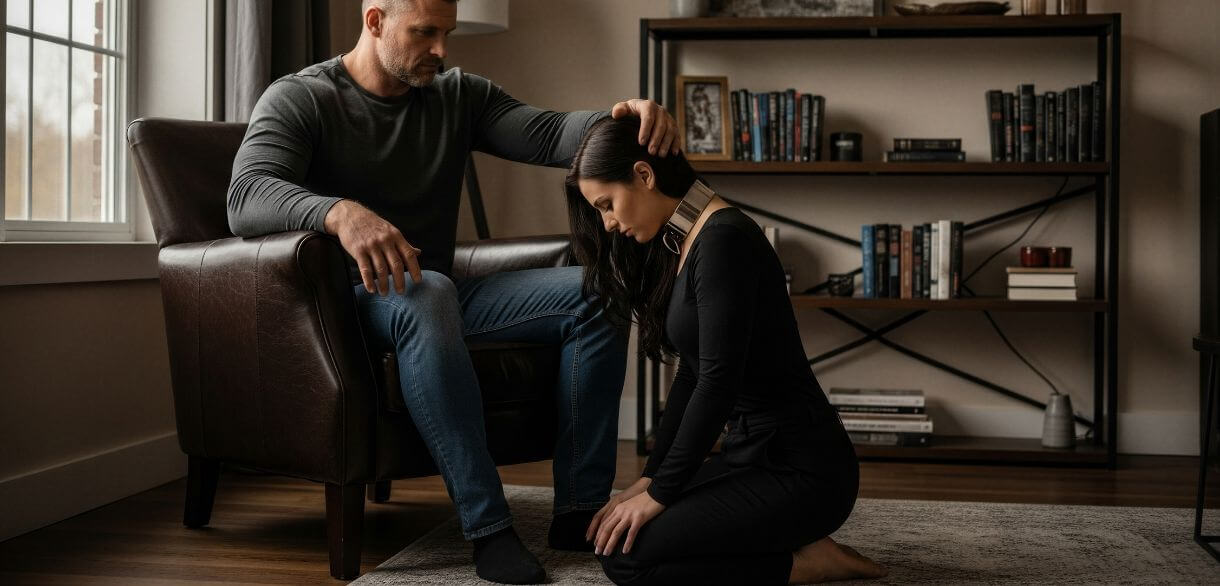
Before deconstructing the myths, it is essential to establish a clear foundation. D/s 24/7 (Domination / submission twenty-four hours a day) is neither a role played permanently, nor a continuous sexual performance. It is a relational dynamic in which the D/s structure is an integral part of daily life, beyond scenes or explicitly BDSM moments.
D/s, BDSM and 24/7: what are we really talking about?
In BDSM, a distinction is often made between scenes (bounded, negotiated periods with a beginning and an end) and relational dynamics. D/s 24/7 clearly belongs to this second category.
A D/s dynamic can exist:
- without regular sexual practices,
- without visible accessories or rituals,
- without permanent staging.
What defines it is not what is visible from the outside, but the consensual distribution of power, the shared intention, and the way each person positions themselves within the relationship.
The term 24/7 indicates that this intention is not limited to a specific time slot: it is woven into the continuity of the relationship, while remaining adaptable to reality.
What “24/7” means… and what it does not mean
Saying that a relationship is D/s 24/7 does not mean that every decision, every word, or every interaction is dictated by a protocol. It means rather that the Dominant / submissive stance is part of the relational identity, even when everyday life takes over.
Concretely, this can mean:
- a clearly defined and consensual hierarchy,
- responsibilities assumed by the dominant person,
- submission lived as an active and deliberate choice,
- regular communication about needs, limits, and adjustments.
On the other hand, it does not mean:
- constant surveillance,
- blind obedience,
- an absence of autonomy or critical thinking,
- permanent sexualization of the relationship.
D/s 24/7 is not defined by the quantity of BDSM practices, but by a shared relational intention that is evolving and explicitly consensual. It is the framework, communication, and mutual responsibility that make it a viable dynamic — not its apparent intensity.
Going further in complete safety
Explore our BDSM resources to better understand consent, communication, and D/s frameworks before putting anything into practice.
Myth #1: “D/s 24/7 means kinky sex all the time”
This is without doubt the most widespread myth surrounding D/s 24/7, and also one of the most misleading. Many people imagine a relationship made up of constant sexuality, continuously visible power play, and a permanent eroticization of daily life.
This vision is understandable. It is largely fueled by popular culture, certain erotic narratives, and a very partial representation of BDSM, often reduced to its most spectacular or exciting aspects. Yet this idea is far from the lived reality of the majority of people engaged in a D/s 24/7 dynamic.
Why this fantasy is so widespread
When discovering BDSM, the entry point is often sexual: domination play, erotic scenarios, intensity of sensations. It is therefore logical to imagine that 24/7 would simply be a “non-stop” version of these experiences.
To this is added a frequent confusion between:
- kink (sexual or erotic practices),
- and D/s as a relational dynamic.
Yet in a D/s 24/7 relationship, sexuality is only one possible element among others. It can be important, occasional, secondary… or sometimes absent during certain periods, without this calling the dynamic into question.
The reality: a dynamic that is above all mental and emotional

In D/s 24/7, what is constant is not sexual activity, but the inner stance. The way partners perceive each other, position themselves in relation to one another, and give meaning to their bond.
The daily life of a couple or D/s 24/7 relationship often looks, from the outside, like any other relationship: work, responsibilities, fatigue, unexpected events, family or social constraints. The difference lies primarily in:
- the intention behind interactions,
- the sense of framework and structure,
- the trust granted to the dominant person,
- the way submission is experienced as a conscious choice.
Sexuality can be present, sometimes very intense… but it is neither permanent nor mandatory. Many people in D/s 24/7 describe their relationship as deeply emotional before it is sexual.
Confusing D/s 24/7 with constant sexuality can lead to unrealistic expectations, or even unhealthy pressure on oneself or one’s partner. A D/s dynamic is not measured by the frequency of sexual acts, but by the quality of consent, connection, and mutual respect.
Myth #2: “In D/s 24/7, you never say no”
This idea is not only false, but also potentially dangerous. It rests on a caricatured vision of submission, often associated with the total erasure of self, automatic obedience, and the impossibility of setting limits.
In reality, a healthy D/s 24/7 dynamic rests on a fundamental principle: consent is permanent, evolving, and reversible. Saying “yes” to a D/s structure never means giving up the right to say “no”.
Where this dangerous idea comes from
This myth often stems from two major confusions. The first is the belief that the authority of the dominant person is incompatible with questioning or dialogue. The second confuses consensual submission with a form of passivity or imposed submission.
In the collective imagination, the submissive person is supposed to accept without discussion, while the dominant person decides alone. This vision completely ignores the reality of lasting D/s dynamics, in which explicit communication is indispensable.

Ongoing consent and the right to refuse
In a D/s 24/7, consent is not limited to an initial agreement. It is expressed and verified over time, through exchanges, adjustments, and sometimes disagreements.
Saying “no”, expressing discomfort, asking for a pause, or renegotiating a framework does not undermine the dynamic. On the contrary, it allows it to be preserved. A relationship in which the submissive person never dares to refuse is not a healthy D/s relationship, but a risky imbalance.
It is also important to note that “no” can take different forms: an explicit refusal, a discussion, an expressed emotion, or simply the need to step back at a given moment.
Establishing regular moments of communication “outside the dynamic” allows both partners to verify that the D/s framework still suits them. These exchanges neither diminish domination nor submission: they make both more solid and more secure.
Myth #3: “D/s 24/7 is inevitably abusive or toxic”
This is probably the most sensitive myth — and the most emotionally charged. It is built on a legitimate concern: that D/s 24/7 might be used as a pretext to exert abusive control, isolate a partner, or deny their fundamental needs.
This fear exists because abuses do genuinely occur. But equating all D/s 24/7 dynamics with abuse means ignoring an essential criterion: informed consent and the ability to question the framework.
Why this fear is understandable
Seen from the outside, a relationship that includes an assumed hierarchy, asymmetric decision-making, or lasting authority can be reminiscent of certain mechanisms found in toxic relationships — especially when BDSM vocabulary is misunderstood or caricatured.
It is therefore normal for people — including within the kink community — to be cautious, even wary, of D/s 24/7. This vigilance is healthy when it serves to protect, but becomes problematic when it prevents any nuance.
What differentiates consensual D/s from an abusive relationship
The difference does not lie in the external form of the relationship, but in its internal functioning. A healthy D/s 24/7 dynamic can be recognised notably by:
- the ability to express disagreement without reprisals,
- genuine consideration of emotions and needs,
- active responsibility taken by the dominant person,
- the freedom to renegotiate or end the framework.
Conversely, an abusive relationship uses the language of D/s to justify fear, guilt, coercion, or isolation. In such cases, it is not domination that is at fault, but its lack of ethics.
If a relationship prevents any questioning, forbids the expression of discomfort, or places the responsibility for suffering on the submissive person, it is not consensual D/s. The BDSM framework must never be used to mask or excuse abusive behaviour.

Structure your dynamic with complete clarity
A clear framework protects both partners. Discover our BDSM contracts designed to establish limits, consent, and responsibilities.
Myth #4: “In D/s 24/7, you must obey at every moment”
This myth flows directly from a very rigid — and often anxiety-inducing — vision of D/s 24/7. It implies that the submissive person is required to obey at all times, regardless of circumstances, their physical or emotional state, or the constraints of daily life.
In reality, this vision corresponds neither to lasting dynamics nor to responsible practices. A D/s 24/7 relationship is not an uninterrupted series of orders to be carried out, but a flexible relational framework, capable of adapting to real life.
Rituals, rules, and protocols: tools, not chains
Rules, rituals, and protocols are often at the heart of D/s dynamics. They serve to structure the relationship, nurture the sense of framework, and strengthen the connection between partners.
However, in a healthy D/s 24/7, these elements remain tools in service of the relationship, not obligations disconnected from context. They can evolve, be adjusted, paused, or even temporarily disappear without the dynamic losing its meaning.
Respecting a protocol only has value if it is understood, consented to, and experienced as coherent by both partners.
When real life takes over
Fatigue, professional stress, health issues, family responsibilities… Daily life sometimes demands a reassessment of priorities. In those moments, D/s 24/7 does not disappear: it reconfigures itself.
Not following a rule on a given day, temporarily reversing certain tasks, or adopting a more functional stance makes the dominant person no “less dominant” and the submissive person no “less submissive”. What matters is the relational intention and the way each person positions themselves within the bond, even when the usual forms are set aside.
In a D/s 24/7, obedience is not a permanent automatism. Rules and protocols are adaptable reference points, not fixed constraints. The strength of a dynamic is measured by its ability to adjust to reality, not by its degree of rigidity.
D/s 24/7 is not a universal model
After deconstructing the most common myths, one essential point deserves to be clearly stated: D/s 24/7 is neither a norm nor a goal to be reached. It is not a “higher level” of BDSM, nor a mandatory step toward a fulfilling D/s dynamic.
Every relationship is unique, and every person has different needs, limits, and life contexts. What works deeply for some may be unsuitable, uncomfortable, or simply unwanted for others — and that is perfectly legitimate.
It is neither an ideal nor an endpoint
In some community representations, D/s 24/7 is sometimes presented as a form of culmination: more committed, more “authentic”, more intense. This vision can create unnecessary pressure, particularly for beginners.
Yet a D/s dynamic can be:
- occasional or tied to specific scenes,
- present only in certain contexts,
- cyclical or evolving over time,
- or fully integrated into daily life.
None of these forms is more “valid” than another. The quality of a D/s relationship is not measured by its duration or apparent intensity, but by the way it is experienced by the people involved.
How to know if this model suits you
Before considering a D/s 24/7, it is useful to ask yourself certain questions, both individually and as a couple. For example:
- Do I genuinely want a structuring daily framework, or is this an idealized projection?
- How do I handle communication, disagreements, and adjustments?
- Are my current life constraints compatible with this type of commitment?
- Am I comfortable with the idea that this dynamic could evolve, or even end?
It is also important to remember that a “no”, a “not now”, or a “not like this” is not a failure. Choosing not to engage in a D/s 24/7, or stepping back from it after reflection, is a decision just as valid as choosing to adopt it.
Taking the time to reflect before committing
Our BDSM resource packs help you clarify your expectations and decide whether a D/s 24/7 is right for you.
Practical toolkit for a considered D/s 24/7
Committing to a D/s 24/7 dynamic does not rest solely on desire or the intensity of the bond. It requires reflection, communication, and the ability to adjust the framework over time. This toolkit aims to provide you with concrete reference points, to be freely adapted to your reality.
Reflection checklist before a D/s 24/7
- Do I have a realistic vision of D/s 24/7, beyond fantasies?
- Am I able to express discomfort or disagreement without fear?
- Is my partner open to communication and questioning?
- Are our respective expectations clearly expressed?
- Have we discussed non-negotiable limits?
Useful communication scripts in D/s

Communication is often more fluid when certain formulations are established in advance. Here are some examples of adaptable phrases:
- “I need to revisit this rule, because it no longer suits me the way it used to.”
- “This framework reassures me, but I’d like to explore how to make it more flexible in certain situations.”
- “I’m feeling a pressure I can’t quite name — can we talk about it outside the dynamic?”
- “What we’re doing suits me, but I need to clarify my current limits.”
Preparing an adaptable D/s framework
A functional D/s 24/7 rarely rests on fixed rules. It is often healthier to think of the framework as evolving. This can involve:
- revisable rules,
- protocols adjustable according to emotional state or fatigue,
- explicitly designated time outside the dynamic,
- regular check-ins to adjust the framework.
Ideas for ethical, non-sexualized scenarios
D/s 24/7 is not limited to sexual practices. Some dynamics express themselves more in daily life:
- beginning- or end-of-day rituals,
- consensual management of certain responsibilities,
- relational recentring or debrief time,
- symbolic gestures of recognition or support.
Equipment recommendations (generic)
Equipment is never mandatory, but certain items can support the dynamic:
- writing supports for setting out rules and agreements,
- symbolic objects as a reminder of the framework (jewellery, notebook, discreet item),
- communication tools (shared journal, notes, reminders).
Deepen your BDSM reflection
Browse our selection of BDSM books to explore D/s dynamics, consent, and power relationships in an informed way.
Conclusion D/s 24/7
D/s 24/7 is often surrounded by fantasies, fears, and shortcuts. By deconstructing these 4 common myths, a more nuanced reality emerges: it involves neither permanent sexuality, nor blind obedience, nor an inherently toxic model, nor a rigid framework imposed at every moment.
Like any BDSM dynamic, D/s 24/7 rests above all on solid foundations: informed consent, ongoing communication, responsibility, and adaptability. When chosen consciously and lived ethically, it can be a profoundly structuring form of relationship for certain people — without ever being an obligation or a norm.
What matters most is giving yourself the right to question, adjust, learn… and choose what makes sense for you, here and now.
FAQ: frequently asked questions about D/s 24/7
Can a D/s 24/7 be stopped once it is in place?
Yes. A D/s 24/7 is never irreversible. Like any consensual relational dynamic, it can evolve, be suspended, or end if one of the people involved no longer finds it right for them. Ending the framework does not erase what was experienced, nor the legitimacy of past choices.
Do you need to live together to be in a D/s 24/7?
No. Some D/s 24/7 dynamics exist at a distance or without cohabitation. The “24/7” refers to the relational intention, not to permanent physical presence. The concrete form depends on context, constraints, and agreements between partners.
Is D/s 24/7 compatible with a professional and social life?
Yes, provided the dynamic is conceived realistically. A healthy D/s 24/7 respects professional, family, and social obligations. When a D/s framework conflicts with daily life to the point of causing distress, it is necessary to adjust it.
Can a beginner consider a D/s 24/7?
It is possible, but it often requires more time, reflection, and guidance. It is generally recommended to start with more occasional dynamics in order to better understand one’s needs, limits, and communication style before considering such a demanding framework.
Does D/s 24/7 necessarily involve strict rules?
No. Some dynamics rest on clear, structured rules; others on a more implicit stance. What matters is not the quantity of rules, but their meaning, their consent, and their ability to evolve.