10 Different Types of BDSM Submission


The submission is one of the most misunderstood aspects of BDSM. For some people, it evokes a loss of power or a form of weakness. For others, it represents on the contrary a conscious choice, a way to experience letting go, trust and sometimes a profound reconnection with oneself.
In reality, there is no single way to be submissive. There are different types of submission, different styles and dynamics: some people seek above all service, others physical sensations, others still psychological control, emotional surrender or a structured lifestyle dynamic.
Understanding these nuances allows you to know yourself better, communicate more effectively with a partner and build healthier, more fulfilling D/s (dominance & submission) relationships.
Some forms of submission are experienced through very specific dynamics, such as service-oriented submission, where attention to the other person’s needs and pleasure becomes central.
This article aims to offer you a clear, nuanced and responsible vision of submission within the BDSM framework:
- without clichés;
- without excessive glorification;
- without judgment;
- and always with respect for consent, safety and communication.
Whether you are questioning, a complete beginner or already practicing, this guide aims to help you explore your own relationship with submission, identify what speaks to you and do so within as ethical a framework as possible.
⚠️ Important:
The “types” of submission are not rigid labels. The majority of people are hybrids, evolving over time, with different partners, experience and life stages.

Essential fundamentals before talking about “types”
BDSM submission is not an absence of power
In everyday life, the word submission is often associated with imposed domination, coercion or abuse. In BDSM, it is the opposite: it is an active choice, made by a person who voluntarily decides to surrender a portion of their power to a trusted partner, within a mutually defined framework.
BDSM submission therefore rests on a fundamental principle: you always retain the ultimate power to say “yes”, “no” or “stop”. Without this power, it is no longer BDSM, but a potentially abusive situation.
Consent, negotiation and the right to withdraw agreement
Every dominance / submission (D/s) dynamic must be founded on clear, free and informed consent. This entails:
- talking about your desires, your limits and your fears;
- defining what is acceptable, what is not and what remains to be tested;
- agreeing on safewords or gestures to stop the scene if necessary;
- accepting that consent is revocable at any time, even if the scene or relationship is already underway.
For a submissive, whatever their way of experiencing it, safety begins there: knowing that you have the right to change your mind, to slow down or to stop, without being made to feel guilty.
A spectrum of submission
There is a wide spectrum of practices. Some people enjoy submitting only during an occasional session. Others appreciate a more regular D/s dynamic in the bedroom. Others still choose a lifestyle, where the dominance / submission dimension structures daily life (sometimes 24/7).
None of these options is “more real” or “more legitimate” than another. What matters is that the level of intensity matches your needs, your emotional capacity and your reality of life.
Fluidity and evolution: you are not a label
We often talk about “types of submission” to help orient yourself, but it is essential to keep in mind that you are not a fixed category.
- You can discover new desires with experience.
- You can enjoy one type of submission with one person, and a different one with another.
- You can be submissive in certain contexts… and dominant or neutral in others.
Rather than trying to stick a definitive label on yourself, it is often healthier to ask yourself:
- What makes me feel safe?
- What excites me, what do I fantasize about, what do I dream of?
- What do I need emotionally after a scene?
These elements will guide you far better than any word or fixed role.
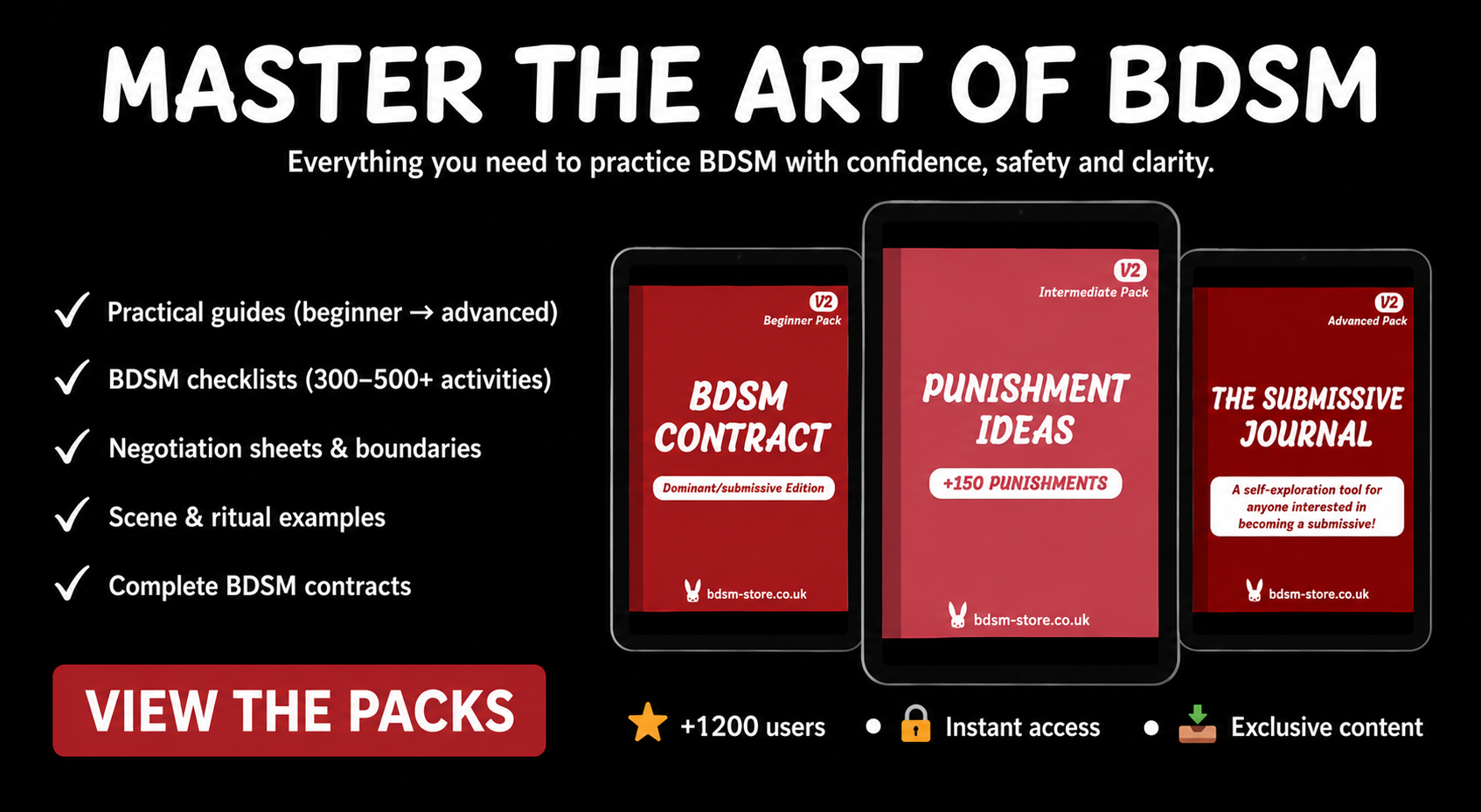
If you are just starting out or want a framework to explore all of this step by step, you can draw on our BDSM resource packs (beginner, intermediate and advanced), with scene examples, negotiation worksheets, submission journals and practical guides to accompany you every step of the way.
The 10 main types of submission

The categories presented below serve as reference points, not closed boxes. The same person can identify with several types of submission at once, or evolve over time, experience and relationships.
1. Service submission (Service Sub)
Service submission is based on the pleasure of being useful, helping, supporting and caring for the dominant. The heart of this dynamic is not pain or humiliation, but making yourself indispensable, organized, attentive and engaged.

- What is sought: recognition, validation, a sense of usefulness.
- Common forms: domestic tasks, daily rituals, logistical assistance, support.
- Key watch point: not losing yourself, avoiding burnout or exploitation.
2. Sensual / physical submission
Sensual submission is centered on the body, sensations and physical surrender. It favors touch, slowness, gentle restraint, breathing, bodily emotions, without necessarily seeking pain.
- What is sought: physical letting go, vulnerability, sensory connection.
- Common forms: guided massage, gentle restraint, temperature play.
- Key watch point: respecting the body’s physical and emotional limits.
3. Masochistic submission
Masochistic submission involves a voluntary pursuit of pain or intense sensations, within a fully consensual framework. Pain becomes here a means of accessing powerful emotional or physical states.

- What is sought: pushing limits, endorphin rush, catharsis.
- Common forms: impact play, prolonged restraint, endurance.
- Key watch point: strict physical safety, breaks, hydration and essential aftercare.
4. Psychological / mental submission
Psychological submission is based on symbolic, emotional or mental control. The submissive may seek disorientation, mental obedience, consensual humiliation or the feeling of total surrender.

- What is sought: mental surrender, emotional intensity, dissolution of control.
- Common forms: verbal commands, protocols, controlled humiliation play.
- Key watch point: strong emotional impact, need for debriefing and enhanced aftercare.
5. Brat submission
The brat is a submissive who enjoys provoking, resisting and testing authority. Submission is built through playful opposition, confrontation and power play.
- What is sought: play, tension, excitement from the power dynamic.
- Common forms: teasing refusals, challenges, verbal provocations.
- Key watch point: avoiding confusion between play and genuine disrespect.
6. Petplay / animal submission
The person adopts the symbolic posture of an animal (puppy, kitten, pony, etc.). This dynamic can be playful, affectionate, regressive or structuring depending on the individuals involved.

- What is sought: simplicity, affection, mental letting go.
- Common forms: role play, accessories, postures, non-verbal language.
- Key watch point: always preserving human identity outside of the play.
7. Slave / M/s 24/7 submission
Slave-type submission operates within a highly structured dynamic, sometimes continuous (24/7). It often incorporates life rules, protocols and a clear relational hierarchy.

- What is sought: strong framework, surrender of control, sense of belonging.
- Common forms: contracts, protocols, hierarchical organization.
- Key watch point: preserving autonomy, life balance and mental health.
8. Ritual / symbolic submission
Ritual submission expresses itself through codified gestures, ceremonies, symbols, sometimes with a spiritual or aesthetic dimension.
- What is sought: meaning, depth, sacralization of the bond.
- Common forms: ritual postures, greetings, commitment ceremonies.
- Key watch point: never confusing the symbolic with real non-consensual submission.
9. Emotional / affective submission
This submission is based on emotional attachment, the need for emotional guidance and the search for relational security. The bond is often very deep.
- What is sought: emotional security, attachment, stability.
- Common forms: consensual emotional dependency, psychological support role.
- Key watch point: avoiding any form of toxic dependency or social isolation.
10. Switch / evolving submission
A switch person can be submissive in certain contexts, dominant in others, or alternate depending on partners. Submission is therefore not a fixed identity.
- What is sought: freedom to explore, variety of experiences.
- Common forms: alternating roles, flexible dynamics.
- Key watch point: clarifying roles at the start of each new relationship or scene.
These ten major forms show just how multifaceted, nuanced and deeply personal submission truly is.
If you want to turn these different types of submission into concrete practices, realistic scenes and guided exercises, our downloadable BDSM resources can help you with checklists, punishment and reward ideas, D/s workbooks and tools to structure your dynamic.
Why we are drawn to one type of submission or another
Being attracted to BDSM submission does not mean you are weak, broken or “abnormal”. On the contrary, it is often a very personal way of exploring power, trust and letting go within a chosen, safe framework.
Different psychological needs according to the types of submission
Each type of submission highlights certain psychological needs. For example:
- Service submission can respond to the need to feel useful, valued and recognized.
- Sensual submission can nurture a need for contact, gentleness, presence and bodily connection.
- Masochistic submission can fulfill a need for intensity, pushing limits and emotional catharsis.
- Psychological submission can respond to the desire for mental surrender, symbolic control or exploration of internal limits.
- Emotional submission can reflect a strong need for security, attachment, guidance and relational stability.
None of these needs is inherently “bad” or “toxic”. Everything depends on the framework in which they are expressed and the way in which they are respected by yourself and your partners.
Personal history and the way we are shaped
Your life history, upbringing, relational experiences and relationship with your body all play a role in what attracts you. For example:
- Some people find in submission a way to let go of the control they must maintain constantly in their professional or family life.
- Others see it as a way to stage emotions (shame, fear, vulnerability) within a safe framework, rather than experiencing them raw in everyday life.
- Others still use submission as a space for rebuilding, to reclaim aspects of themselves they have long suppressed.
This is not about over-psychologizing every desire, but about recognizing that your way of loving submission is part of a unique personal story.
The search for structure, reference points and security
Certain types of submission, particularly service submission, slave / M/s submission or ritual submission, offer a structuring framework. Rules, protocols and hierarchy can be reassuring for people who like to know where they stand and what is expected of them.
When this framework is healthy, clear and negotiated, it can provide a genuine sense of security. When this framework becomes rigid, guilt-inducing or non-negotiable, it can slide toward something far less healthy. The boundary often hinges on:
- the ability to say “no” or “stop”;
- the acknowledgment of your needs and well-being;
- the presence or absence of mutual respect.
Intensity, escapism and role change
For many, submission is a way of accessing an emotional intensity difficult to find elsewhere: adrenaline rush, intense sensations, raw emotions, liberating tears, a feeling of unity with the partner.
For others, it is above all a way to experience a change of role compared to daily life: a highly responsible, autonomous and in-control person in their “vanilla” life may find immense relief in being guided, taken care of or directed in a BDSM context.
No attraction is “more legitimate” than another
It is common to wonder whether one is a “true submissive”, whether one is “intense enough” or “too soft”. In reality, what matters is not the degree of intensity, but the fact that your way of experiencing submission is:
- consensual;
- discussed and understood by your partners;
- safe for your body and your psyche;
- in line with your limits, your values and your life.
Whether you are drawn to a very gentle submission or to more intense dynamics, your experience is legitimate as long as it is lived within an ethical framework that respects everyone involved.
How to identify your type of submission
Many people wonder: “What is my type of submission?” This is a legitimate question, but it is important to approach it as an exploratory process, not as a search for a fixed definition.
Asking yourself the right questions before any classification
Even before looking for a word to define your submission, it is useful to reflect on what you actually feel. For example:
- What makes me feel safe in a D/s dynamic?
- What brings me pleasure, relief or excitement?
- Do I need gentleness, intensity, structure, challenge, affection?
- What are my non-negotiable limits (physical, emotional, relational)?
These answers often paint a far more accurate picture of your profile than simply ticking a “box”.
Distinguishing between fantasy, curiosity and deep need
It is common to fantasize about certain very intense forms of submission without actually wanting to experience them. Fantasy allows you to explore the imagination, while practice involves the body, emotions and reality.
- A fantasy can remain a fantasy without frustration.
- A deep need, however, tends to recur repeatedly in one’s desires.
Learning to make this distinction helps you avoid throwing yourself into experiences that do not truly match what you are ready to live.
The importance of communication with your partner
Your type of submission is not discovered alone in your own corner. It is also built through discussion, exchange and progressive experimentation with a trusted partner.

- Talking about what attracts you without pressure.
- Clearly expressing what you do not want.
- Voicing your fears, doubts and expectations.
A healthy D/s dynamic relies on transparency far more than on performance.
Accepting that your submission evolves over time
It is very common to start with a “soft” form of submission, then discover with experience an attraction for more structured dynamics, or conversely to return to something simpler.
Changing does not mean you were “wrong” to begin with. It means you are learning to know yourself better. The only truly problematic thing would be forcing yourself to stay in a role that no longer suits you.
Beware of labels used as obligations
Words like “slave”, “service sub”, “brat” or “pet” can be useful for understanding yourself… but they can also become confining if used as injunctions.
If you hear:
- “A true submissive must do this…”
- “A true submissive must accept that…”
then it is time to step back. In BDSM, there is no universal model of good submission, only consensual dynamics between specific individuals.
Safety, consent and ethical framework according to the types of submission
Whatever your type of submission, the priority always remains the same: preserving your physical, emotional and relational integrity. BDSM submission only makes sense when it operates within a consensual, negotiated and reversible framework.
Before the scene: negotiation, limits and safewords
A solid D/s dynamic begins well before the session. The more intense the practice (masochistic, psychological, slave, 24/7…), the more essential upfront negotiation becomes.
- Talk about your desires: what type of submission attracts you? More service, sensation, masochism, mind games, rituals, brat, petplay?
- List your limits: what is absolutely excluded (hard limits), what remains to be explored gently, what is already comfortable for you.
- Define safewords: for example, a word to say “stop immediately” and optionally a word to say “slow down / adapt”.
- Establish a clear framework: duration, planned practices, level of nudity, intensity, control, etc.
This preparation phase takes nothing away from the magic of the scene. On the contrary, it creates a space where trust can truly take hold.
During the scene: listening to your body, emotions and subtle signals
Once the dynamic is underway, it is not about “enduring everything at all costs”, but about staying attuned to what you are actually feeling.
- In masochistic submission, monitor your breathing, unusual sensations and unexpected sharp pain.
- In psychological or emotional submission, pay attention to overflowing emotions, painful memories surfacing and feelings of panic.
- In a slave / 24/7 dynamic, watch for signs of fatigue, loss of vitality, isolation or anxiety.
Using a safeword, requesting a pause or a full stop is not a failure. On the contrary, it is a sign of responsibility toward yourself.
After the scene: aftercare and emotional return
The more intense a scene is (physically, mentally or emotionally), the more important aftercare becomes. It encompasses everything that happens afterwards, to help everyone return to a stable state.

- Physical care: hydration, blanket, tending to marks, light food, rest.
- Emotional care: cuddles if desired, reassuring words, listening, validation of what was experienced.
- Psychological care: time to talk about the scene, naming emotions, identifying what was particularly intense or sensitive.
Aftercare should not be reserved for the submissive person: dominants may also need support after an intense scene.
The specific limits of the 24/7 lifestyle and highly structured dynamics
For slave / M/s submission or very regimented dynamics, it is essential to add additional safeguards.
- Autonomy: you must retain personal spaces, resources and social connections outside the D/s relationship.
- Reversibility: even within a 24/7 dynamic, it must remain possible to renegotiate or end the agreement.
- Mental health: if submission begins to erode your self-esteem, your professional life, your family bonds or your health, it is time to reassess the framework.
A D/s relationship, even a highly hierarchical one, remains a relationship between two people of equal worth, who freely choose to play with unequal roles.
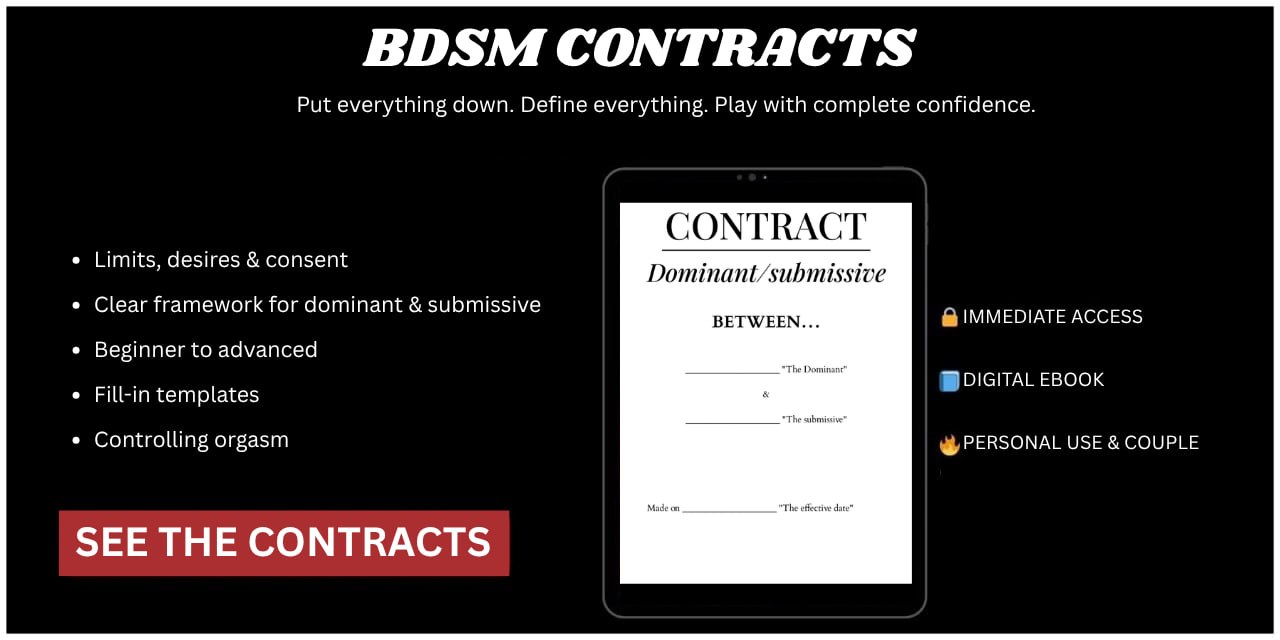
If you are considering a more committed dynamic, such as a Dominant/submissive, Master/slave or Daddy/little contract, you can draw on ready-to-customize BDSM contract templates to set out in black and white the rules, limits and responsibilities of each party.
Recognizing warning signs
Certain behaviors should alert you, regardless of your type of submission or level of commitment:
- your “no” is not respected, or is ridiculed;
- you are made to feel guilty when you set a limit or use your safeword;
- you are isolated from your loved ones or your needs outside the relationship are minimized;
- you are made to feel that you must “prove” that you are a “true submissive”.
In such cases, it is legitimate to distance yourself, ask for help or end the relationship. No BDSM dynamic, whatever it may be, justifies endangering your integrity.
A practical toolkit for conscious, ethical and safe submission
This toolkit aims to give you concrete reference points to experience your submission in a more serene, structured and self-respecting way, as well as with respect for your partners.
Checklist before committing to a D/s dynamic
- Have I identified what truly attracts me about submission?
- Do I know my physical, emotional and relational limits?
- Am I comfortable with the idea of saying no, even in the middle of a scene?
- Do I have a trusted person outside the relationship I can talk to if needed?
- Does this relationship respect my personal, professional and social life?
Communication script for talking about submission with a partner
You can draw inspiration from this type of phrasing to open the dialogue:
- “I want to explore submission, but I need to go at my own pace.”
- “What attracts me most is the (service / sensations / mental control / emotional) aspect.”
- “My non-negotiable limits are the following…”
- “If something becomes too intense for me, I would like to be able to use a safeword without being judged.”
- “I will need aftercare after certain scenes, especially if they are emotionally intense.”
A clear discussion prevents a great deal of misunderstanding and unnecessary hurt.
Mental and emotional preparation for a session
- Identifying your emotional state before the session.
- Not forcing yourself if you feel fragile, tired or anxious.
- Having eaten, drunk and slept sufficiently.
- Setting aside quiet time after the scene.
Ideas for ethical scenarios according to the type of submission
- Service: preparing a meal, welcome rituals, organizing a space.
- Sensual: guided touch session, gentle restraint, controlled breathing.
- Masochistic: progressive intensity play with pauses and enhanced aftercare.
- Psychological: verbal commands within a very defined framework and a clear exit from role.
- Petplay: short role play with a return to human identity afterwards.
- Brat: playful challenges within a framework of mutual respect.
Equipment recommendations
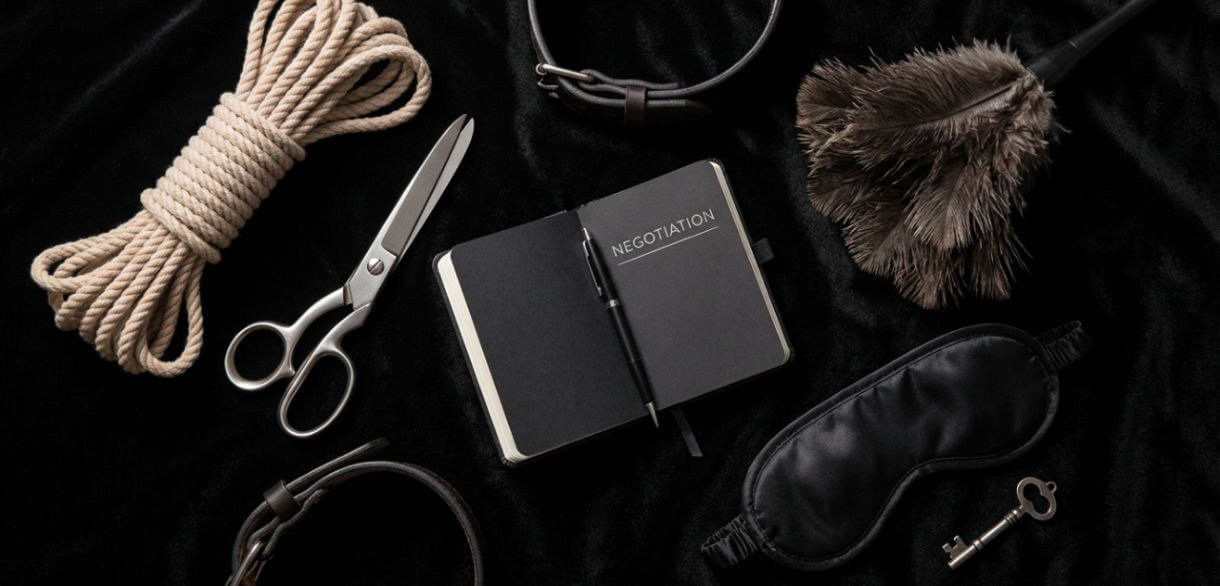
- For safety: safety scissors, a clear safeword, hydration.
- For comfort: blankets, cushions, easy-to-remove clothing.
- For sensations: soft accessories, temperature objects, wide restraints.
- For aftercare: water, sugar, a throw blanket, time for discussion.
Equipment alone never makes the quality of a dynamic. It is above all communication, trust and attentiveness to the other person that guarantee a healthy and enriching experience.
Conclusion: there is no single way to be submissive
Exploring the different types of submission allows you above all to better understand just how diverse, nuanced and deeply personal BDSM submission truly is. Some people thrive in service, others in sensations, others still in mental surrender, play, emotional connection or structured lifestyle dynamics.
There is no hierarchy between these forms of submission. None is more “pure”, more “real” or more “legitimate” than another. The only valid compass remains your consent, your safety and your well-being.
You have the right:
- to explore at your own pace;
- to change your mind;
- to evolve;
- to refuse what no longer suits you;
- and to build your own way of being submissive.
Submission is neither a weakness, nor an obligation, nor a sacrifice of your worth. It can be a space of trust, inner freedom, pleasure and transformation, provided it is experienced within a clear, respectful and conscious framework.
And if you want to go further, structure your practice or feel better supported, you can discover our BDSM resource packs (beginner, intermediate, advanced): negotiation worksheets, submission journals, simplified contracts, comprehensive checklists and workbooks to build a D/s dynamic that truly reflects who you are.
If this article has helped you understand yourself better, put words to some of your desires or reflect on your limits, then it has fulfilled its purpose. You deserve a submission that elevates you, not one that breaks you.