BDSM Contract: Everything You Need to Know


A BDSM contract is a document that details the expectations of two people in a dominant and submissive relationship with each other.
It consists, most of the time, of clear instructions given by the dominant partner to the submissive, but it can also include elements that the submissive should expect from the Dom.
It is not legally binding, but it demonstrates a certain degree of seriousness in the BDSM relationship. Each person can refer to the contract whenever they need to remember what was agreed upon.
BDSM contracts are more typical of formal “outside the bedroom” D/s relationships (such as master and slave) than of those who only practice dominant sex in the bedroom.
If you want to take your relationship to the next level with your partner, we suggest you visit our BDSM accessories.
Why have a BDSM contract?

BDSM contracts are important because:
- They clearly define the role and responsibility of the submissive to avoid any confusion.
- They are a means for the submissive to verify that they are satisfied with what the dominant expects of them, and to avoid being forced to do something that does not suit them.
- They elevate the level of a Dom/sub relationship, making it more real.
What should a BDSM contract contain?
A BDSM contract can contain:
- Details about the rules, duties and submission rituals that the submissive must fulfil for the dominant.
- Agreed names to call each other
- Hard limits and other boundaries (sexual and non-sexual). (Within the framework of these limits, you may want to explore new BDSM practices. For safe practice, consult our article “Understanding the importance of the SSC and RACK acronyms“)
- Information that needs to be known, such as important medical issues that may have an impact on play.
- A punishment clause detailing what happens if the submissive does not behave as expected.
A BDSM contract can go into the details of each of these categories and contain pages of information. It can also have just a short paragraph for each of them.
As an example, an abbreviated version of a contract in the punishment section might say:
“You will be punished if you do not behave as expected. The Master will decide the punishment, ensuring it does not exceed your limits.”
A more formal contract may list all the punishments that can be imposed, with a severity that varies depending on the infraction.
That is why even vanilla sexuality consultants recommend signing a written contract in interpersonal relationships.
Who drafts the contract?

Normally, it is the dominant partner who drafts the contract, as they are the one with expectations regarding their submissive. It is the submissive who must read the contract, suggest modifications, and sign it when they are satisfied with everything it contains.
But it doesn’t have to be this way. A submissive may have more experience drafting contracts than their dominant, or the dominant may assign them the task of drafting their own contract.
What format should a contract be written in?

A contract does not need to be a formal document, although ideally it should be so that each person has a clear understanding of their roles and responsibilities.
If you are in a more casual D/s relationship, it could be a verbal agreement, an email, or a message sent via WhatsApp.
BDSM purists will say it should be an official document, signed by both parties.
We don’t believe that is necessary in every relationship, but do consider it. Yes, it takes more work to draft the contract, but it will be clearer and easier to refer back to later.
What to include in contracts

We recommend creating it in Google Docs so you can easily share it with your submissive or your dominant.
Creating your own BDSM contract will also give you more flexibility than buying a ready-made one. This way you can personalise it according to your Dom/sub relationship and include the elements you consider important.
Below you will find examples of sections you might want to include:
- Duties and responsibilities. What are the responsibilities you expect from your submissive? What are their duties in the relationship, at home, when you are in public, etc.
- Expectations. What do you expect to gain from having a Dom/submissive relationship? Useful for making sure all parties are on the same page.
- How to refer to each other. How should the submissive refer to the dominant? And vice versa? Are there any words that are forbidden? Some submissives take offence at certain explicit words but are perfectly fine with others.
- Orders. If you are a service submissive, what orders do you expect your Dom to give you and how should you act when they are given.
- Other people. If you are in a non-monogamous relationship, how are you going to handle others? What role should they play in your relationship? If you are in a monogamous relationship, where are the limits? For example, if you are at an erotic play party and want to touch another partner, is your partner okay with that?
- Punishment. How will the submissive be punished or corrected if they do not respect the rules? And what measures have you taken to ensure the submissive’s safety (such as having a safeword)?
- Training schedule. You can create a complete training programme for your submissive slave, describing exactly what their BDSM slave training will consist of over the coming weeks and months.
- Progress chart. Everyone loves seeing a gold star next to their name. Why not create a progress chart or a reward system where your slave can see their progress.
Examples of BDSM contracts
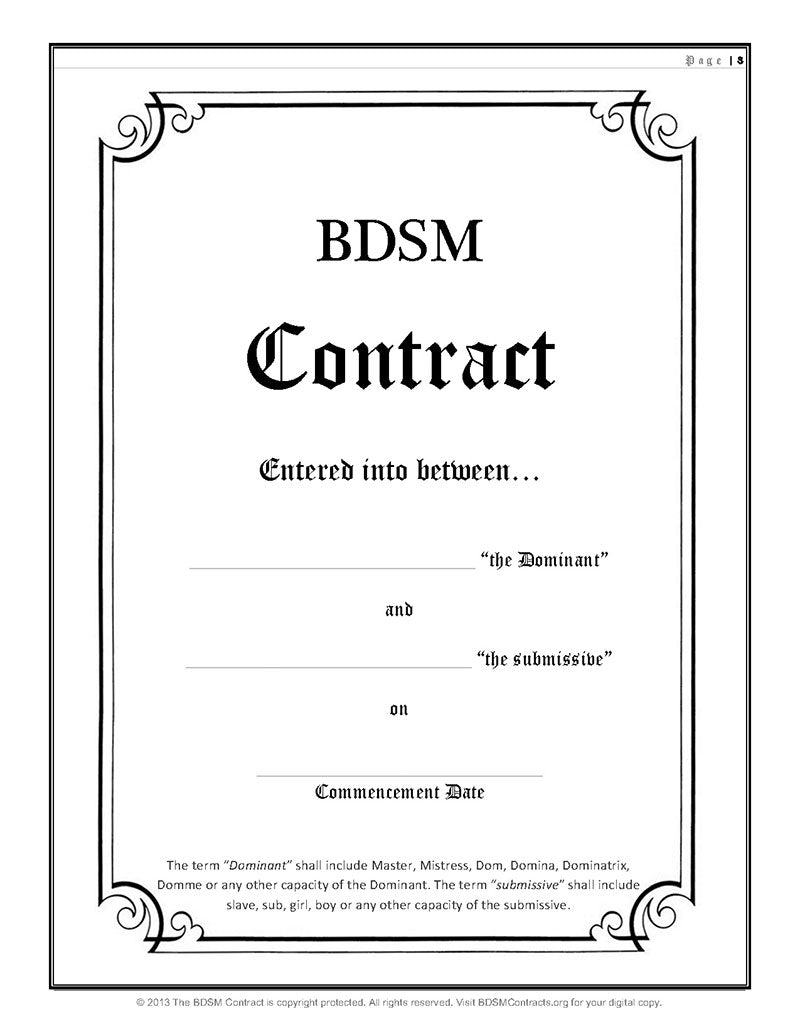
BDSM contract for beginners
This “beginner” BDSM contract simply establishes a safeword and instructions for referring to the dominant during the scene. A safeword is a word, phrase, or even an action that the submissive can use to slow down or stop scenes when they become too intense. The red, green, yellow system works well. If a dominant checks in and everything is going well, a submissive can respond with “Green”. When things need to slow down or not progress further, the submissive can say “Yellow”. When the stimulation is too intense, the submissive can respond with “Red” to stop the BDSM play entirely.
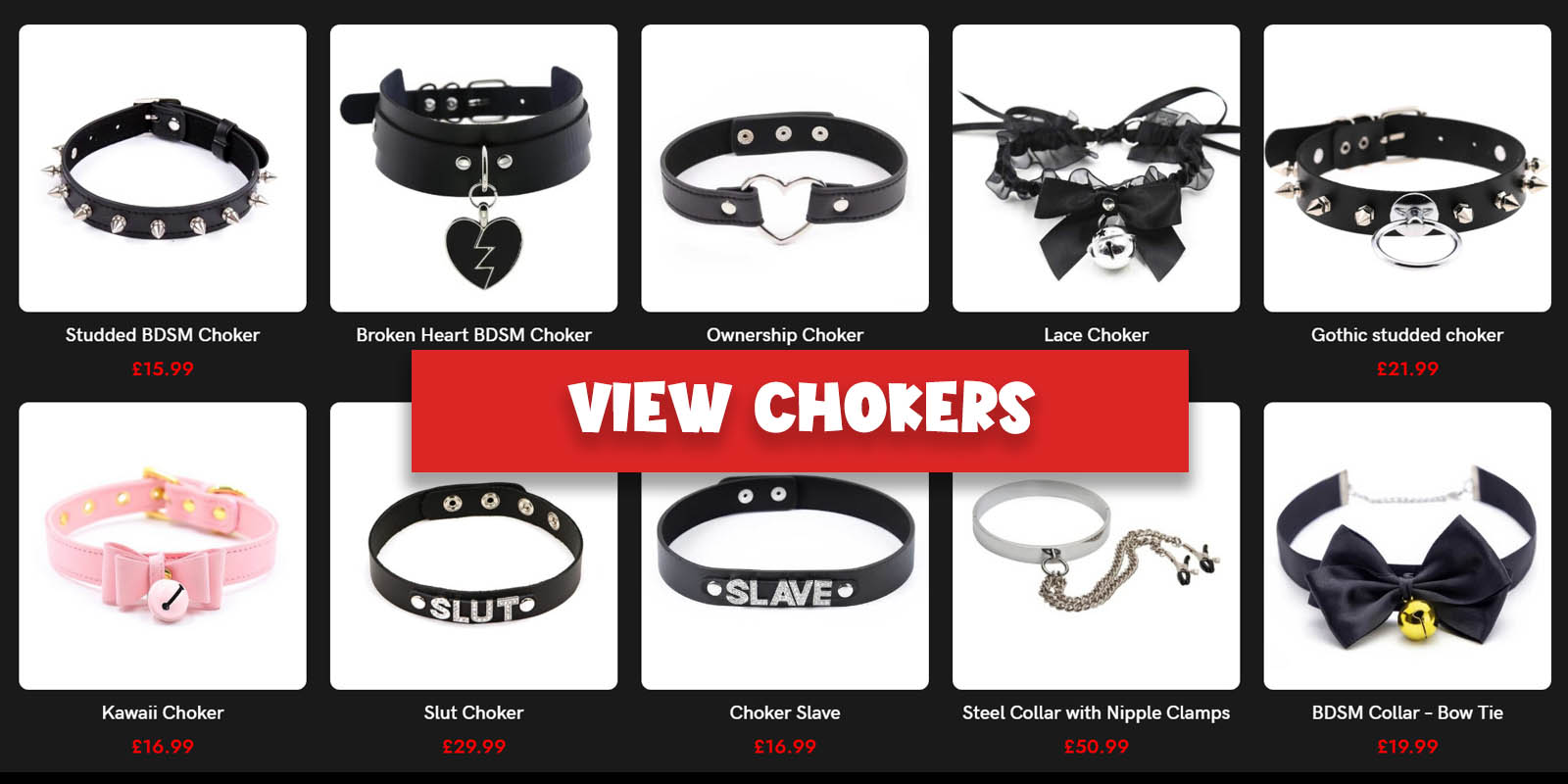
You can start gently with BDSM collars so as not to hurt your partner too much.
This contract allows for a certain degree of freedom and is particularly suited to light bedroom bondage.
- Chosen safeword:
- Dominant’s name/title during the scene:
- Submissive’s name/title during the scene:
- Do you have any health issues, in particular STIs, conditions such as asthma or anxiety, or ongoing medications?
- Are there any other concerns? List fears and limits (hard and soft), medical conditions or medications, as well as any other information that may help the scene proceed safely.
This simple contract allows the submissive to alert the dominant to any concerns, for example, STIs that could be transmitted in the event of contact with blood. A submissive can add anything to the considerations. For example, skin that marks easily or the need to avoid marks in areas covered by clothing would both be appropriate cases.
Specifying the names or nicknames to use during a bondage scene helps create the right atmosphere. It is common to use names such as “Master” or “Mistress” for the dominant, but you can also opt for your real names if you prefer. Nicknames such as “daddy”, “girl”, “sir” or “slut” are also common, and this light BDSM contract will help you establish the rules.
As your relationship and your comfort with bondage evolve, you can modify your contract. For example, you may initially indicate that blindfolds are a hard limit, but you will become more comfortable with their use as you and your dominant grow more at ease.
Contract between dominants and submissives
Once you have moved beyond the stage of beginner BDSM activities, you may need a more structured and detailed contract.
- Who is involved
- Who plays which role (and the titles used)
- Where scenes take place
- Duration of the scene
- Agreement on accidents that may occur during a scene
- Limits – hard, soft, physical and emotional
- Whether sex or sexual contact is permitted
- Whether intoxication is permitted
- Who will be restrained and with what force?
- The type or intensity of pain the submissive prefers.
- Whether leaving marks is permitted
- Whether humiliation is permitted
- Safeword
- The fantasies the submissive wants to experience.
- Aftercare protocol
- Any other ideas.”
This more advanced contract takes into account all the information included in the basic contract, while also adding space to specifically address location, pain tolerance, fantasies, intoxication and humiliation.
Aftercare, one of the last points on the list, refers to post-scene activities that allow a submissive to safely return from their sub space and the intense physical and emotional sensations that BDSM can provoke. Examples of aftercare activities include cuddling, massages, offering food or drink, the use of a blanket, playing relaxing music, or lighting a candle or incense. Aftercare may not be as necessary in lighter scenes, but it helps a submissive reconnect with themselves, their dominant and their surroundings after a BDSM session.
In a more advanced version of this contract, the contract provides for people who may watch, whether recording is permitted, role reversal, how the submissive should respond to the dominant, resisting the dominant, wearing a slavery collar, medical conditions and history, emergency contact, STI status, experience with bondage, where marks may be left from impact play, extended aftercare and feedback. Your contract can be far more concise, especially if you are only venturing into light bondage with someone you know well. However, more detailed BDSM contracts allow you to play safely with strangers.
BDSM lifestyle contract
For those who practise BDSM as a lifestyle, it is an activity that takes place 24 hours a day, 7 days a week, and the scene never ends. A lifestyle BDSM contract is often more formal than other types of contracts, and you can renegotiate it periodically, just as you might sign a new lease for your home after a set period. In fact, adding renegotiation to your lifestyle contract is a great idea!
The advanced contract may also be known as a “slave” contract. In these situations, control is consensually removed from the submissive to the point of being “owned” by the dominant. Evil Monk describes a BDSM slave as “a person who has freely and completely given up all freedom for the benefit of one or more specific people in a structured relationship in order to satisfy their need to serve another person.”
A lifestyle situation can be difficult to maintain if you are not committed to the submissive or dominant mindset, whatever role you play in your relationship. However, couples who maintain a BDSM relationship 24 hours a day, 7 days a week, will find a contract such as the following useful as a reference for the permitted and expected behaviour of partners.
“I, [Submissive], request that [Dominant] accept my submission. I grant ownership of my mind and body and accept that you will care for and protect my free will and open heart. Through this agreement, we can strengthen our bond and increase our intimacy.
I commit to offering my body to satisfy all your needs. The use of my body will be at your discretion. Furthermore, I will strive to better respond to your needs and accept your guidance throughout this journey.
To this end, I will adapt my physical, emotional and mental attitudes to the best of my ability.
I trust that you will provide guidance during scenes that will help me grow as a submissive and throughout life to stimulate my growth as a person.
Both together and apart, I cede to you control of my sexual pleasure and my physical and emotional well-being. Furthermore, I accept that there will be no secrets between us, that all questions will be answered with honesty, and that intimacy will be granted to me by [Dominant]. It is therefore my responsibility to share with you all my fantasies, limits, feelings and needs without hesitation and to work towards removing the mental obstacles that could prevent such communication.
I accept any punishment you deem appropriate should I fail to fulfil this contract and meet your expectations.
I grant you ownership of my mind, body and soul, with the understanding that my physical, emotional and mental safety will be guaranteed. Endangerment of life or livelihood permits the termination of this contract.
Should the need to revise the contract arise before the expiry date, I agree to verbal negotiation.
Consent under this contract begins on [Date]. This contract will expire on [# days/weeks/months], at which point the contract may be renewed or a new contract created and agreed upon.
[Submissive’s signature]”
There are several fields, including the names of the participants, the date and the duration of the contract, which you will fill in upon signing the slave contract. Apart from the duration, few details are addressed. This is because a lifestyle contract grants the greatest control to the dominant while removing the most freedom from the submissive. Signing a contract of this type with a person (submissive or dominant) you do not know well is strongly discouraged.
BDSM contracts and you
The great thing about a BDSM contract is that it can be tailored to your preferences. Although contracts generally exist for submissives, yours could include a section where a dominant also lists all of their hard limits. After all, a submissive may agree to play with a knife, but a dominant may prefer not to draw blood. Likewise, a couple who switches roles can create a contract that allows each person in the couple to specify their preferences both as a submissive and as a dominant in the scene.
If you want to be precise about potential interests, a list such as Vampires Pet’s allows submissives to comment on activities they have experienced and would like to experience, both in the context of fantasy play and in real life. This list could also be adapted to include columns for limits.
Whatever form your contract takes, it can be a beneficial tool that ensures the comfort and safety of everyone involved. BDSM checklists and contracts of this kind are an excellent way not only to determine what is unacceptable, but also to open up new avenues of BDSM exploration.
Now that your contract is ready, what better way to take it to the next level than with our SM accessories! You are sure to have a fantastic time with all these accessories!