BDSM: A Complete Guide for Beginners

Looking to get started in BDSM? You’re in the right place. Whether you’ve read a sexy book, watched a sexy scene in a movie or a porn film, or your partner wants to try it with you, you’re probably here because you want to learn more. Whether you’re here out of pure curiosity or burning desire doesn’t matter. What matters is that if you don’t have a good understanding of what BDSM is and if you don’t understand some of the best practices, you and your partner could get hurt or turned off simply because you don’t have all the necessary information.

This guide will help you get started in learning a whole new kinky world you may not even have known existed. Are you ready? Let’s begin.
What is BDSM?
BDSM is both a lifestyle and a form of kinky sex. You can play with certain elements of BDSM without ever having sexual relations. Yet, you may find that BDSM becomes an integral part of your sexuality and your relationships. There’s no single way to “do” BDSM. Followers of this lifestyle can be men, women, transsexuals, straight, gay, or anywhere on the spectrum of human sexuality.
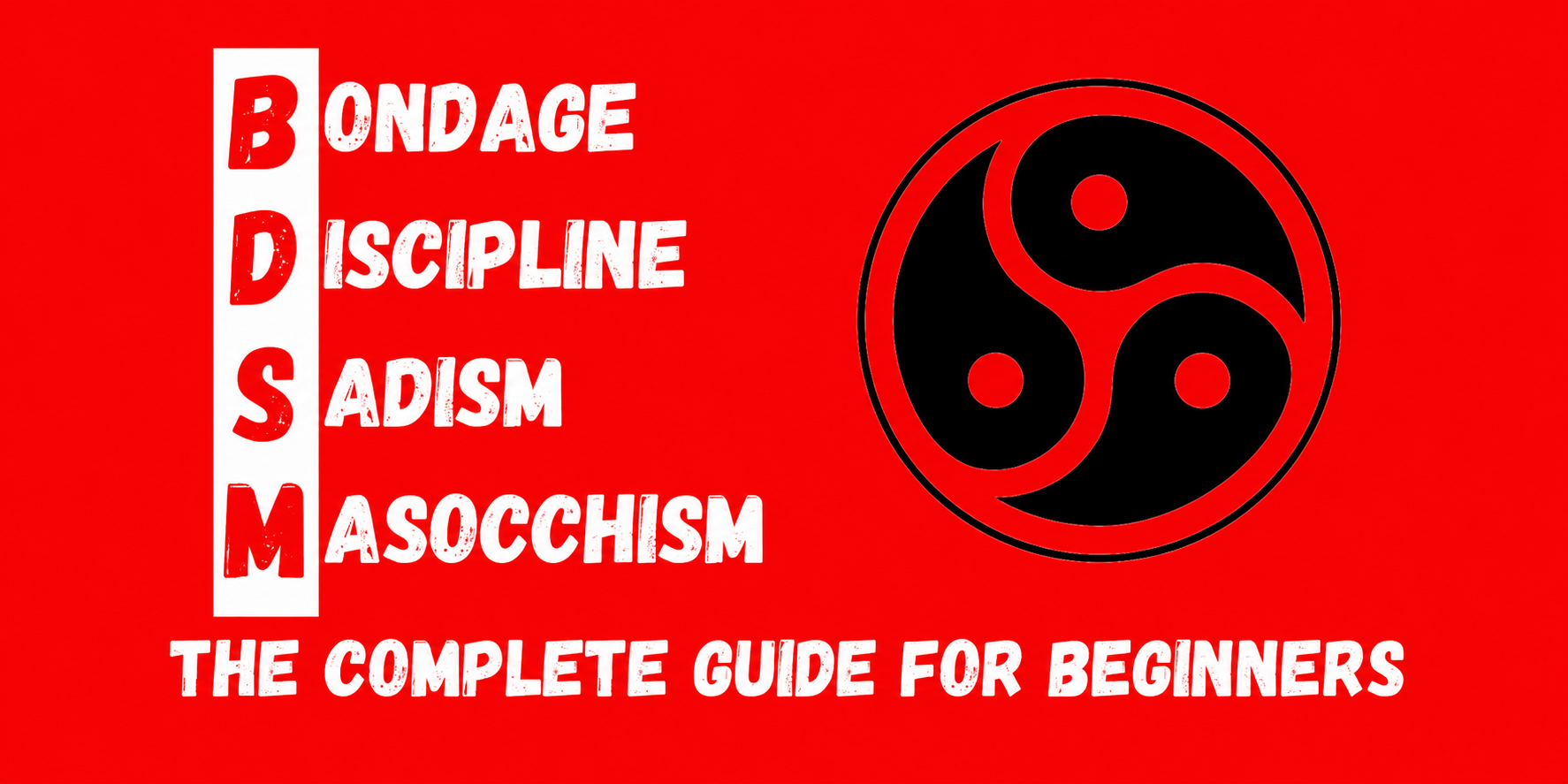
Let’s break down the acronym “BDSM” into its multiple parts:
Bondage and discipline

At first glance, bondage and discipline don’t seem to go together. Bondage refers to physical restraint: ropes, handcuffs, belts, etc. Discipline refers to psychological and mental restraint: following rules and protocols or modifying your behaviour to suit another person.
Understand this: restraint doesn’t always require toys or rope. Honour bondage is the willingness to maintain a position (for example, hands clasped above your head or behind your back) until you are “released”. Curiously, it takes a lot of discipline to be able and willing to be bound by honour in this way.
If you’re just starting out in the world of BDSM, we suggest you visit our wide range of BDSM accessories. You’ll enhance your sexual sessions with your partner!

Discipline often involves following specific rules or guidelines, either for a short period, such as the duration of a scene, or as part of a long-term relationship or a negotiated power exchange. Following specific protocols is also part of discipline. This can include always using specific titles such as “Sir” or “Ma’am” or not speaking to someone until given permission to do so.
People who are new to the BDSM lifestyle often find that discipline is one of the most difficult aspects to learn and follow. Bending to the will or whims of another person isn’t easy. Being told what to eat, where to go, or how to do something, especially if you’re a fairly independent person, requires a great deal of trust and willpower in addition to a desire to please.
Domination and submission

Domination and submission, commonly referred to as D/s, can happen in different ways, online or in the real world. Dominants and submissives are sometimes referred to as tops and bottoms, although these terms aren’t automatically interchangeable. In a power exchange, someone is on “top” or dominant, and someone else is on the “bottom” or submissive to their partner. It’s possible to identify as a “top” or “bottom” without calling yourself dominant or submissive.
While D/s is often described as a sexual preference, most people will tell you it’s a lifestyle. In a relationship or situation, the dominant is granted a specific and defined amount of control by their submissive. This happens in BDSM scenes between two people who aren’t a couple, as well as in long-term, romantic, committed relationships, and everything in between.
The amount of control and power a dominant accepts happens after a lot of communication and negotiation with a consenting submissive partner. Sexual D/s or bedroom D/s, the 24/7 lifestyle, and play partners are all commonly found in D/s. However you approach D/s, one thing always remains true: all control and power must be accepted by both the dominant and the submissive.
Sadism and masochism

Sadism and masochism are most often confused by newcomers to the BDSM lifestyle as a requirement of domination and submission. It’s not necessary to be sadistic to be dominant or masochistic to be submissive.
Sadists find pleasure in giving pain. Masochists find pleasure in receiving it. Pain takes multiple forms. Mental pain is often known as a mindfuck, which involves making the dominant, submissive and/or masochist believe that something is going to happen or is happening that they find painful or frightening. A good sadist can make the scene seem so real that you’re convinced the knife is actually cutting you, the fire is actually burning you, or the person touching you is a stranger.
Physical pain can range from a light spanking to acts that draw blood or cause burns. Whatever type of pain you enjoy or are willing to try, whether you’re a sadist or a masochist, you must respect your personal limits.

As with all other parts of BDSM, the practice of sadomasochism, as it’s sometimes called, can be separated from sexual activities. Some sadists find pleasure in spanking or engaging in wax play with people outside their relationship. Masochists, on the other hand, can play with a sadist who isn’t their partner, especially if that partner doesn’t identify as a sadist.
BDSM is a set of practices that can take place within or outside an established relationship. Sex isn’t a requirement or an automatic end result of BDSM play. It’s not necessary to like every aspect of BDSM to live this lifestyle. As you’ll see later in this guide, everything done under the umbrella of BDSM falls on a spectrum ranging from light play to intense play. There’s no single way to play or be kinky. The only real requirement is consent and safety.
Bondage and discipline are the two halves of a whole, even if they don’t seem to go together. Bondage involves restraining the body while discipline restrains the mind. There’s a spectrum for each, from light to heavy. Sex may or may not be part of it. It all depends on your personal preferences and those of your partner.
Bondage

Bondage is the act of tying, binding or restraining your partner consensually. Bindings may be intended to be beautiful, to create sensations in the body, to be erotic, or a combination of the three. Bondage comes in many forms. It can be as complicated or as simple as you want it to be. Handcuffs and silk scarves are just as legitimate a form of bondage as more complex options like shibari.
Forms of bondage
Regardless of what you use to restrain your partner, the purpose of bondage can take several forms. It’s not always about kinky sex.
Erotic bondage

Any bondage used as part of sex is erotic bondage. Some people find that tying or being tied up is erotic in itself, even outside of sex, which is also a form of erotic bondage.
Decorative bondage
This type of bondage has no specific function. It’s simply pleasant to look at. You’ll see it most often in photography, but it can also be used in places like BDSM parties to adorn a bottom that can serve the party guests or to showcase a bottom as art or furniture during the event. (Yes, this really happens).
Predicament bondage
When a person is given two choices, both considered painful in some way, and must choose the lesser of two evils, this is called predicament bondage. For example, a person is forced to balance on their toes (which isn’t easy) or stand flat-footed and have their hair pulled because it’s tied by a rope to a hook in the ceiling. There’s a chance, though not a requirement, that in such a situation, the top is probably a sadist and the bottom a masochist.
Torture bondage

Being tied up or bound in a painful or difficult-to-manage way is torture bondage. If you’ve ever searched the internet, you’ve probably seen images of men and women tied with their arms behind them or legs over their heads.
Sometimes you’ll see a woman’s breasts tied until they turn purple. This looks painful, and probably is. Sometimes it’s part of a sexual act, but not always.
Materials and methods used for bondage
Anything you can imagine can be used in bondage if it has the ability to enclose, tie, or physically restrain someone. Metal, leather, latex, fabric, or rope are the most common materials. Rope bondage is probably the most popular in erotic photography and the most easily recognisable.
Japanese bondage has become more popular over the years. The official practice is known as kinbaku, which means “tie tightly”. The other term you may know is shibari, which simply means “to tie”. The two terms may be used interchangeably, but the term “shibari” is often used for any type of rope bondage, regardless of its purpose. Shibari is purely aesthetic while kinbaku is erotic. Both forms use thin rope made of hemp or jute to create a simple yet complex bondage pattern. Whatever term is used, Japanese bondage is probably the most easily recognisable type of rope bondage.
Bondage safety
Safety is paramount in all aspects of the BDSM lifestyle, but especially in bondage, where blood circulation can be impaired or airways cut off. There are specific things to do and keep in mind so that everyone stays safe and healthy.
- Always get consent. This is non-negotiable.
- Play sober. When you’re drunk or under the influence of drugs, your judgement is impaired. You won’t be able to make the best decisions for yourself or your partner.
- Never leave your bound partner alone.
- Change position at least once an hour to avoid circulation problems.
- Keep scissors nearby so you can quickly untie them in case of emergency.
- Use a safe word or gesture (in case a gag is being used).
- Practise before you play. Learn from other members of the BDSM community and practise on stuffed animals or pillows before practising bondage on a real person. It’s too easy to hurt yourself or someone else when you don’t know what you’re doing.
Discipline

Even though it doesn’t seem to go hand in hand with bondage, discipline is a form of mental restraint and can take many forms. Discipline requires a certain amount of training, self-control, obedience, willingness to follow rules, and acceptance of authority. Both partners have a role to play in this area, and it’s not always easy to do.
Bottoms or submissives must be ready to do what they’re told, without question, when given an order. They must also be ready to follow implicit orders because they already know what’s expected of them based on previously established rules and expectations.
Any breach of discipline and obedience has consequences, often in the form of punishment. If you’re a bottom or a submissive, this may seem easy to do during kinky sex and become more difficult outside the bedroom. Discipline, from your point of view, means you’re willing to follow rules and hand over control of everyday functions or actions to your partner. For tops or dominants, the responsibility of discipline can be difficult to bear. Consistency is key to ensuring rules are followed and consequences are imposed when they’re not. Only you can decide whether you can maintain discipline even when the rest of your life goes crazy and you’re not sure you have time to devote to it.
Examples of discipline

Discipline can take various forms and be as simple or as complex as you choose to negotiate for your specific situation. It can be sexual, service-oriented, or a combination of the two.
Mental bondage is the ability to take on a physical position and hold it for a set period of time or until released. Human furniture or art exhibits are examples of mental servitude. This can also apply to something as simple as maintaining a specific position during kinky play, such as a spanking. It’s harder than you think.
Rules are a form of discipline often created to nurture and care for a bottom or to help achieve personal goals or even a sense of autonomy. When to go to bed, how to dress, and how to address other members of the BDSM community are examples of rules that may be put in place.

Protocol is a way of behaving in specific situations, such as calling your Dominant “Sir” or not speaking without permission. In the local BDSM community, certain protocols are followed when meeting for the first time. At a munch or in a club, you may find that Dominants won’t speak to a claimed submissive without permission, or that all Dominants must be addressed by a specific title, regardless of their relationship with you. Some people don’t care much about protocol, but others care a great deal and consider the use of proper protocol a sign of respect.
Consequences and punishments
As with everything related to BDSM, discipline and how it works in your relationship must be agreed upon from the start. The same goes for consequences. You must give your consent to all activities, good or bad. If a possible consequence is a hard limit for you, it must be respected. Consequences for disobeying a superior vary from person to person.
Here are some examples:
- Kneeling in a corner
- Having your mouth washed out with soap
- Not speaking for a certain period of time.
- Withdrawal of privileges
- Spankings for those who don’t like pain
- No spankings for those who like pain.
Consequences are meant to deter bad behaviour in the future. They should be quite unpleasant, but should never cause permanent damage or harm. The idea is to ensure that rules are followed to avoid consequences, or that experiencing a punishment prevents someone from breaking the rules in the future. It’s a bit like raising children, except that as an adult, you can enjoy a bit of kinky sex or a glass of wine after facing the consequences.
The way you play with bondage or discipline will be different from the next kinkster, and that’s normal. If you only like handcuffs or asking permission to have orgasms during sex and at no other time, you’re just as much an adept of bondage and discipline as someone who spends hours making complex knots and asking their partner permission to go to the toilet. Play levels may vary, but as long as you have your partner’s full consent, nothing else matters.
What could be better than having comprehensive resources at your disposal to develop your practices and deepen your BDSM dynamic? You might be surprised by new perspectives.
There are many misconceptions about domination and submission, known as D/s or Ds. One of them is that D/s is misogyny at its worst, with submissive women being abused and/or brainwashed. Another misconception is that men are always dominant and never submissive in a relationship. Yet another is that D/s always involves sex. Let’s clear up these inaccuracies and explain domination and submission in more detail.
Domination and Submission (D/s)

Power exchange
At the heart of any D/s relationship, sexual or not, is a consensual exchange of power. One person, the Dominant, is given control while the submissive grants it. Notice we didn’t say control was taken. Taking control without consent has no place in BDSM, especially in dominance and submission, and constitutes pure abuse. Consent is granted after communication and trust have been established and limits and desires have been discussed and negotiated.
You may be wondering how dominants and submissives differ from tops and bottoms. Anyone can be a dominant or submissive in a BDSM scene or sexual situation. Dominants and submissives internalise these power exchange roles as part of their identity. In other words, BDSM is the physical act while D/s is the relationship between two people (or more). When a dominant has control, they also take on a certain responsibility towards their submissive.

The dominant must ensure the physical, mental, and emotional wellbeing of their submissive, whether during a single BDSM scene or as part of a long-term relationship. In a scene, it’s important to ensure no one gets hurt, as play can sometimes become extreme. In a relationship based on mutual care, appreciation, and respect, this responsibility is often an integral part of the Dominant’s nature.
Submissives can grant as much or as little control as they wish and that their Dominant is willing to accept. Many submissives have professional lives that require them to exercise authority and control. Submissives are also parents and caregivers. They must be in charge and in control at all times. For many, being dominated is a relief from the daily stress of life.
But at its core, D/s is a negotiated and consensual exchange of power. One person is in charge, and the other isn’t. The degree of control varies from relationship to relationship. No two relationships will ever be identical.
BDSM isn’t always about sex

Dominant and submissive acts aren’t always sexual. We know a “couple” who plays hard in the dungeon. They’re best friends, but nothing sexual exists between them. She’s a single bisexual woman and the dominant. He’s a single gay man and her submissive. Their relationship is first one of friendship, then of power and control. Ask a submissive what they get out of D/s, and it’s rare that they’ll only talk about kinky sex, forced orgasms, and other more erotic aspects of the dynamic. They’ll tell you that they can finally quiet the noise in their mind, focus, and rely on someone they trust to look after their interests even when they don’t.
Think about it. How many times have you told yourself you wouldn’t eat junk food, you’d go to the gym, and you’d sleep more at night? We know we should do these things, but for a number of reasons, we don’t. In a D/s relationship, the dominant can set a bedtime, send their submissive to the gym, and require them to ask permission before eating certain foods. If you notice, none of this is sexual, and the submissive reaps most of the benefits. A good Dominant doesn’t only think of themselves, even though it may seem that way from the outside. You might hear them say “I’m going to take what’s mine” and assume the submissive only exists for their Dominant’s pleasure. Look closer. Both are engaged in a scene or sexual act they both enjoy. At all times, a safeword must be available to stop the moment or scene in case of fear, pain, or worry.
Dominants and submissives come from all walks of life. They’re rich or poor, educated or not, married or single. They can be men, women, transgender, straight, gay, lesbian, bisexual, and everything on the gender and sexuality spectrum. Despite what you may have read, not all D/s couples consist of an alpha male billionaire and his reluctant, stubborn submissive-to-be.
D/s safety tips

Since D/s is the relational aspect of BDSM and can exist without kinky sex, just as you can enjoy BDSM without considering yourself a Dominant or Submissive, there are many safety aspects to consider. Most advice is aimed at submissives, since they’re the ones giving control to dominants and putting themselves at risk. A safe word absolutely must be used, especially in new relationships.
When meeting someone for the first time, be sure to tell trusted friends where you’re going and who you’ll be with. Set up a safety call. This is a call you’ll make at a specific time to let your friends know you’re okay. If they don’t receive your call on time, they should call you. In a worst-case scenario, if they can’t reach you, they should be able to reach you or call the local police to let them know you might be in danger.
As a submissive, if a Dominant approaches you, online or in the real world, and imposes demands on you without trying to get to know you, you’re free to, and should, tell that person that you don’t appreciate their behaviour. Tell them no, leave the situation, or do what you need to do. You have no obligation to submit to a Dominant simply because you’re submissive.

Domination is earned, not taken. You don’t have to consent to any type of play, scene, or sexual act that makes you uncomfortable. If you consider something a hard limit or something you don’t want to try, you’re not obligated to do it. Anyone who violates your consent or ignores a safe word isn’t safe to play with and is abusive. Put distance between you as soon as possible. If necessary, call the authorities.
Dominance and submission aren’t for everyone, even if you enjoy kinky sex. There are responsibilities and expectations, both for dominants and submissives, that must be met for the dynamic to succeed. Open and honest communication is an absolute necessity. Trust and respect will follow if communication is honest. Once these three elements are in place, you can create the D/s dynamic that works best for you, whether you’re married with three children, asexual and single, or looking for the right person. Whatever the case, your relationship will be unique to you and your partner and will only need to meet one requirement: it must be consensual.
Sadism and masochism (S/M)

Whether you call it sadism and masochism, sadomasochism or S&M, this branch of BDSM is probably the most misunderstood element. Considered a psychiatric illness by Sigmund Freud in 1905 and whose name comes from the Marquis de Sade, a man who doesn’t seem to have cared much for consent, sadomasochism can be the most violent of all BDSM activities and presents the greatest danger.
Sadists and masochists derive sexual pleasure from pain, whether physical or emotional. The sadist likes to give pain, while the masochist likes to receive it. As a general rule, sadists are the dominants (or dominants in D/s) and masochists are the submissives. Contrary to popular belief, not all sadomasochistic games end in sexual intercourse, even if it’s an exciting experience for the players. In fact, sex isn’t a “requirement” in D/s relationships.
If you’re a sadist, you might enjoy inflicting pain, degradation, humiliation, or anything that can cause your consenting masochist to suffer. As a masochist, you enjoy feeling physical pain, being humiliated, or simply suffering for your superior or dominant. For outsiders, sadomasochism can be hard to bear. Tears, bruises, and marks are common. Many masochists view bruises or marks as trophies and badges of honour for having both enjoyed and endured something difficult.
Different types of S/M play

Sadomasochism can involve physical or emotional pain. Physical pain is the most common and spans a wide range of activities:
- Nipple and clit clamps
- Cock and ball torture
- Wax play
- Knife play, with or without drawing blood.
- Bondage aimed at causing pain. Breast bondage is a classic example. The breasts are tied tightly, causing blood to build up. When the ties are released, the return of circulation can be excruciating;
- Forced orgasms. One orgasm is good, two is better, but multiple orgasms on sensitive genitals can be painful.
- spanking. For some followers of the BDSM lifestyle, spanking is an element of punishment and discipline for bad behaviour, but in sadomasochism, it serves a completely different purpose.
If it causes pain, and you and your partner enjoy it, you can add it to the physical sadomasochism column, even if you don’t find it on common lists.
On the other side of things, humiliation and degradation are a form of emotional SM play. A sadist may use derogatory language towards the masochist, such as “fat”, “stupid”, “ugly”. Other forms include begging, being treated like an animal or piece of furniture, face slapping, kissing or licking feet, and many others. If a person finds it humiliating, it can be included, even if a casual observer wouldn’t recognise it as such.
Consent and safety in sadomasochism
What separates the sadist from the abuser who should be imprisoned comes down to one word: consent. As with all elements of BDSM, full communication and disclosure are essential to the safety of SM play. A safe word must be usable at all times, and when a submissive person is unable to communicate verbally (most often when gagged), a hand signal or other device must be used. Sadomasochism can cause physical and emotional injury and shouldn’t be practised lightly.

For newcomers to sadomasochism, no activity should be undertaken without some prior knowledge or training. For example, if you’ve never used a whip, your partner’s buttocks or back aren’t the first place to try it out. Meet other followers of this lifestyle at a BDSM club, watch videos online, and practise on a pillow before trying something on a real person.
Responsible sadists in the BDSM lifestyle understand the importance of consent and don’t engage in any activity without it. Masochists have a responsibility to share their concerns and/or medical history so they aren’t unintentionally injured by the physical or emotional pain inflicted on them. A person who has suffered abuse in the past and feels triggered in certain situations will need to reveal this so that their partner doesn’t engage in something that could trigger an episode.
It’s a good idea for anyone practising BDSM, but especially sadists and masochists, to get certified in first aid and CPR. Even with excellent preparation, plenty of communication, and thorough knowledge, things can go wrong during play or a scene. Knowing what to do in an emergency can save someone’s life.

While bruises and marks are a badge of honour for many masochists and physical, rough play is often loud and can seem angry, don’t think your consent will be accepted in a local court or by the police. Be careful about when and where you play. If you have nosy neighbours or thin walls, and they think abuse is happening, they might call the cops. Depending on where you live, even the appearance of abuse can land you in prison. Play it safe and smart.
For those of us who enjoy it, sadism and masochism increase sexual pleasure. But understand clearly that just because we enjoy kinky pain doesn’t mean we enjoy other forms of pain. On that note, we’ll leave you with one last thought: a classic sadomasochism joke:
“Hurt me, hurt me!” cries the masochist.
The sadist replies: “No.”
We don’t know of a better description of sadism and masochism than that.
The importance of communication in BDSM

Communication is the most important aspect of BDSM. It doesn’t matter if you only enjoy spankings from strangers or if you’re in a 24/7 Master/slave relationship. Nothing in BDSM should happen without good communication beforehand.
What does communication look like?
“I really don’t like it when you touch me there.”
“I’m not interested in [fill in the blank with your most hated activity or fetish].”
“I liked it when you kissed my neck, but when you bit me. That hurt, and I didn’t like it.”
“I’m allergic to latex.”
“I have asthma.”
The philosophy that you should tell your partner everything isn’t just a trend. It’s not just about building a solid relationship or finding the love of your life (although these two things are certainly by-products of good communication). Talking and sharing details about yourself, what you like, what you don’t like, what you think, and your health has an impact on your BDSM experience.
If you think certain details are simply too personal to share, remember that this person will most likely see you completely naked while you’re drooling, sweating, squirming, and shouting. How can you get more personal than that?
Communicating your needs

Both parties, top and bottom, dominant and submissive, must be able to communicate their needs to each other. This lets you know if you’re compatible. A sadist needs to know if the other person is a masochist. Before tying someone up with rope, you need to know if your partner has poor blood circulation or suffers from anxiety when they can’t move freely.
Sometimes the result of this communication is that you learn you don’t want to play with this person at all. Sometimes the result is that you decide to do other activities together. BDSM isn’t a one-sided event. Two people (or more) are involved and each must have their needs met, but no one can magically know what you need and want.
If you want to improve your communication, set your limits clearly and structure your exchanges, having the right BDSM resources is a real asset. Guides, contracts, negotiation sheets and self-exploration tools can help you better understand yourself, better understand your partner, and build a solid foundation before any practice. Good communication always starts with good tools.
Set aside your fear of hurting your partner’s feelings. As long as you treat the other person with respect when telling them what worked or didn’t, a mature person will be able to handle the situation. The only way for both people to enjoy what’s happening is to know what excites you and, when you try something new, what doesn’t.
Communicate your limits
“I don’t like Golden Showers or scat play. Bodily fluids disgust me. So, before I engage in BDSM activities with a new partner, I tell them. If I don’t make it clear that I don’t like this kind of play, I risk getting a big surprise at some point and not finding it sexy, erotic, or satisfying. Who wants kinky sex or BDSM play that isn’t satisfying? What would be the point? And yet, that’s what happens when you don’t tell someone what your limits are.”

The advantage of communication in BDSM, especially when setting limits, is that you can always go back and change your mind. If you communicate regularly with your partner, you can tell them that you’ve been thinking about a previous limit, such as gagging, and that you’d like to try it. Just because you’ve set a limit at one point doesn’t mean you can’t change your mind about it later. You just need to communicate with your partner about it.
Trust and intimacy
What can communication give you beyond fun and kinky BDSM play? It strengthens trust and intimacy between you and your partner. When you talk to each other about your desires, needs, cravings, what worked, what didn’t, and your limits, you learn more about each other than you ever thought possible.
Baring your soul to another human being is a source of power and inspiration. It brings you closer to that person. Knowing that they communicate in the same way and share the smallest details of their personality brings you closer together. Not everyone who engages in BDSM play is looking for a romantic relationship or long-term partnership, but the effects are the same, whether you’re communicating with your spouse, your partner, or your favourite kinkster at the local club. You’ve created a strong bond between you that you may never know with anyone else in your life.
Safe words and control

If you’re new to the BDSM lifestyle, you may be surprised to learn that dominants and submissives actually have more control than you think. A good Dominant or Top will never violate a hard limit that has been communicated to them. Nor will they engage in new activities before discussing them with their client or submissive.
Communicating boundaries and hard limits is one aspect of the control a submissive exercises; the other is the use of safe words. A safe word is a word or phrase that, when used, means all play must stop immediately. Some people use a colour system. Green means continue, yellow means slow down, and red means stop. Other people use words and phrases that have no meaning in the context of the scene, such as “pineapple” or “purple elephant”. Your safe word can be anything you want. Just make sure everyone involved in the scene knows it. If a submissive or bottom is unable to communicate verbally during a scene, a hand signal must be established.

Safe words help communicate a feeling of danger, unpleasant pain, or other feelings and sensations that mean play or the scene must stop immediately. Dominants and tops closely monitor their play partners during a scene to avoid going too far or causing pain and distress. This can still happen. Using a safe word is nothing to be ashamed of, and no one should feel bad about needing to use it. If a safe word is used repeatedly in scenes or other play, you should talk to each other to figure out the underlying issue, whether it’s physical pain, fear, worry, or a hard limit you weren’t aware of.
If consent is key to BDSM in general, then communication is the essential first step. You can’t consent to anything without discussing it in some way. Throughout a scene, kinky play, or relationship, you must keep communicating so that no one ever has to wonder whether there’s consent for an activity or not. If you don’t like something, it’s your responsibility to tell your partner. No one is a mind reader, and you’ll only get out of BDSM what you put into it. Set aside your fear of rejection and ridicule and openly discuss what you like, what interests you, your fantasies, desires, needs, cravings, and yes, the things you don’t really like, are afraid of, or consider off-limits. Only then can you experience the full beauty and eroticism of BDSM.
SSC and RACK

Consent and communication are the two most important factors in BDSM. The reality is that some practices and games can be dangerous to a person’s physical, mental, or emotional wellbeing. BDSM practitioners use different methods to determine whether an activity is safe and acceptable. Some people use the SSC method (Safe, sane and consensual) while others follow the RACK method (Risk-aware consensual kink). Both share the same underlying concept of consent and safety. Deciding which principle to follow is a personal decision, like everything else about BDSM, but it’s helpful to have a basic understanding of each.
Safe, sane and consensual
The three parts of this concept are fairly self-explanatory. Stay safe. Don’t try a new activity – such as suspension bondage, for example – without having first learned and practised it. Don’t use a whip for the first time on a person; use a cushion until you’re used to the movements and sensation. Ask other kinksters who know more than you about an activity. Learn by reading, watching, and talking to people. Oh, and practise, practise, practise before trying it on your partner.
Stay sane. Be reasonable in the activities you choose. A sense of danger can be sexy and erotic, but real danger can land someone in hospital. Don’t do anything that carries a real risk of injury, unless you’re both trained in that activity and know how to handle emergencies. If you still want to attempt something dangerous, make sure you’re certified in first aid and CPR.

Stay consensual. Whether by using a safe word or communicating hard limits and boundaries, don’t do anything without your partner’s full consent. When in doubt, stop and ask. Yes, even in the middle of a scene. Asking “Do you want me to continue?” can be erotic, but even if it isn’t, ask anyway.
Risk-aware consensual kink
RACK is used most often by those who fear that SSC is too vague and too broad. One person’s idea of mental health may differ from another’s. Being risk-aware means ensuring that everyone involved is fully aware of the risks. Knife play carries the risk of drawing blood. Fire play can cause burns. Breath control can lead to asphyxiation. Before trying, you need to know the actual risks.
Consensual. There’s that word again: consensual. Have you discussed what you want to do together? Do you know the safe word? Does this fit within your limits? If you can’t answer these questions, it may not be consensual. Stop and talk about it first, then play and have fun in a kinky way.
If it’s outside the “mainstream”, it’s probably kinky. However, one person’s “kinky” is another’s “vanilla“. Here’s how to know if you need RACK. Do you consider what you’re about to do to be kinky? If the answer is yes, then you need RACK.

Neither SSC nor RACK is perfect and neither includes every possible variation or situation. Some kinky games involve a genuine element of danger (which is part of the appeal for some people). Don’t try a new activity with your partner before doing research, asking questions, and practising on an inanimate object, if possible. This helps reduce potential dangers. Whichever you choose, SSC or RACK, follow them, use them, and be smart in your kinky activities. There’s nothing fun about ending up in the emergency room explaining a third-degree burn or a deep cut.
BDSM Community
We’re in the real world where not everyone likes everyone else for various reasons. Unfortunately, too many people don’t like others because of their skin colour, sex, sexuality, culture and, yes, even their kinks. Kinksters know what it’s like to hide their desires, worry about legal issues, and face rejection from friends and family. That’s why the BDSM community is, for the most part, an open and tolerant group. Even if we don’t share the same tastes, we know exactly what it’s like to be kinky in a vanilla world.

That said, in any group, you’ll find people who don’t always follow this idea of acceptance. Don’t be one of those people. It’s okay not to enjoy or even want certain fetishes and kinky games. There’s nothing wrong with telling your partner that certain forms of play are off-limits. It’s never acceptable to judge someone because they play differently than you.
Remember the golden rule
Remember, all that matters in BDSM is safety, consent, and communication. What happens between consenting adults stays between them. Outside opinions are neither necessary nor wanted. Don’t hesitate to express your dislike or discomfort with an act or scene. That’s your right. Don’t try to make someone feel bad because they enjoy something you find unpleasant.
Think about it: if you want to explore BDSM, your friends and family may question your mental health, morality, and ethics because, unfortunately, kinksters are often seen as sexual deviants. Don’t treat another kinkster the same way just because they enjoy scat play, golden showers, or any other fetish or kink you don’t like or understand. Treating others as you wish to be treated worked when you were younger, and it works now.
In most cases, members of the BDSM community will welcome you with open arms, whatever your personal inclinations. Be sure to show the same courtesy to others.
BDSM Recap

There’s a lot of information to absorb about BDSM, whether you’re into light spanking or leather gear, whips and chains. There are only a few real rules in BDSM:
- Consent is paramount. Without consent, it’s not BDSM or kink, it’s abuse.
- BDSM requires open and honest communication, otherwise it won’t work.
- Be careful and understand the risks when trying new things.
- There’s no single right way to do BDSM. Everyone has different tastes and wants something different.
Let’s recap a bit of what you’ve learned and read:
- Sex isn’t a requirement in BDSM.
- You can be a top, a bottom, or a switch. This can change with different partners.
- Domination and submission (D/s) is a relationship status in BDSM, whether that relationship is sexual or not.
- You can keep BDSM confined to the bedroom or, as with D/s, integrate it into your daily life.
- The kinks you enjoy today may be different over time.
- Everyone should have a safe word to use, at least at first.
- All BDSM activities lie on a spectrum ranging from light to heavy, and all are legitimate BDSM acts.
If you remember nothing else, always remember this: your kink isn’t my kink, but your kink is acceptable.
What consenting adults do with each other stays between them and doesn’t affect your kinky play. Do what you enjoy, always remember the rules, and discover who you are and what you like in the big, fun, kinky world of BDSM.
If you’ve made it this far, it’s because you’re genuinely interested in BDSM and want to deepen your understanding of this world. To keep learning, structure your practices, and grow with confidence, we invite you to discover our BDSM resources. Guides, contracts, checklists, and self-exploration tools are there to support you at every step of your journey.
All that’s left is for you to enjoy your sexual sessions with your partner with all the accessories you want to grab!